


Details
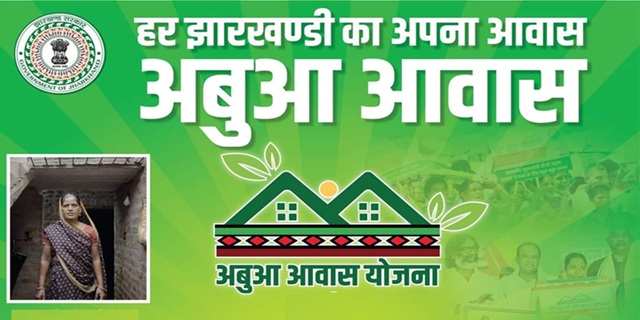
The “Abua Awas Yojana” was launched by the Department of Rural Development, Government of Jharkhand. The scheme aims to provide pucca houses to 8,00,000 homeless families in three phases with a budget of ₹16,320/- crore, prioritizes housing for vulnerable and underprivileged families, providing financial and labor assistance for construction. Each house will feature three rooms and a kitchen, covering an area of 31 square meters.
Benefits
Financial assistance of ₹2,00,000/- per beneficiary for house construction.
Provision for 95 days of unskilled labor wages under MGNREGA.
Eligibility
The families living in kutcha houses or without permanent housing.
The specially vulnerable tribal groups (PVTG), victims of natural calamities, and released bonded laborers are eligible for this scheme.
The family should not be benefited from existing housing schemes like PMAY-R, Indira Awas Yojana, or Birsa Awas Yojana.
Application Process
Offline
Online-https://aay.jharkhand.gov.in/
Step 1: The interested applicant should visit (during office hours) the Block or District Office and request a hard copy of the prescribed format of the application form from the staff exclusively entrusted to issue and collect filled-in applications.
Step 2: In the application form, fill in all the mandatory fields, and attach copies of all the mandatory documents (self-attest, if required).
Step 3: Submit the duly filled and signed application form along with the documents to the Block or District Office.
Step 4: Request a receipt or acknowledgment from the concerned authority to whom the application has been submitted. Ensure that the receipt contains essential details such as the date and time of submission, and a unique identification number (if applicable).
Documents Required
Aadhaar Card.
Bank Passbook.
Job Card.
Address Proof.
Caste Certificate.
Any Other Document If Required.
Adivasi Sanskriti Evam Kala Kendra/Majhi Bhavan, Manki Munda Bhavan, Parha Bhavan, Pargana Bhavan, Dumkuria Bhavan Evam Gosade Nirman Tatha Majhi Than Shed Nirman Yojana
Details
The “Adivasi Sanskriti Evam Kala Kendra/Majhi Bhavan, Manki Munda Bhavan, Parha Bhavan, Pargana Bhavan, Dumkuria Bhavan Evam Gosade Nirman Tatha Majhi Than Shed Nirman Yojana” by the Scheduled Tribes, Scheduled Castes, Minorities, and Backward Classes Welfare Department, Government of Jharkhand aims to preserve, protect, and develop tribal culture and traditions. Under this scheme, essential infrastructure, including community centers, cultural hubs, and traditional venues, are built to serve the tribal population as focal points for cultural and social activities.
Benefits
Grants and Allocations: Financial assistance of ₹25,00,000/- to ₹5,00,00,000/- per project, based on the scope of work and infrastructure required.
Construction of Cultural Hubs: Dedicated centers for tribal cultural preservation such as Majhi Bhavans, Dumkuria Bhavans, and Pargana Bhavans.
Basic Infrastructure Development: Facilities include boundary walls, multipurpose halls, drinking water arrangements, seating spaces, driveways, and parking.
Beautification and Cultural Representation: Tribal-themed landscaping, wall paintings, and decor to showcase tribal traditions.
Eligibility
The applicant should represent a village with a significant tribal population.
The applicant village must have recognized traditional tribal leaders, such as Manki, Munda, or Pahan.
The applicant committee must be formed under the leadership of tribal leaders with 7-11 tribal members.
The applicant village must have government-approved land for the construction of the infrastructure.
Exclusion
Villages with no recognized tribal leadership (Manki, Munda, etc.) are not eligible.
Non-tribal community members cannot be part of the beneficiary committee.
Application Process
Offline
Formation of Beneficiary Committee:
Conduct a Gram Sabha meeting in eligible villages.
Form a committee under the leadership of recognized tribal leaders.
Appoint a chairperson, secretary, and treasurer within the committee.
Proposal Submission:
Submit the proposal to the District Welfare Officer (DWO) or ITDA Project Director.
Ensure the proposal includes the required documents.
Approval Process:
District Welfare Officer reviews and forwards the proposal for technical and administrative approval.
Final approval is granted by the department and sanctioned funds are disbursed.
Documents Required
Gram Sabha Resolution.
Proposal for Infrastructure Development.
Land Ownership Certificate (Government-recognized).
Beneficiary Committee Details (Including Tribal Leader Authorization).
Bank Account Details of the Committee (Joint Account).
Technical Project Plan and Cost Estimate.
Disclaimer
Hamara Neta is an independent, private application developed and maintained by HANSA AI TECHNOLOGIES. This app does NOT represent any government entity and is NOT affiliated with, endorsed by, or connected to any government body. Official government services should be accessed directly through their respective government portals.